
TexVision — AI Fabric Defect Detection Platform
Two-stage computer vision inspection system combining YOLOv8 bounding-box defect localization with a fine-tuned ResNet50 neural network for automated textile manufacturing quality assurance.
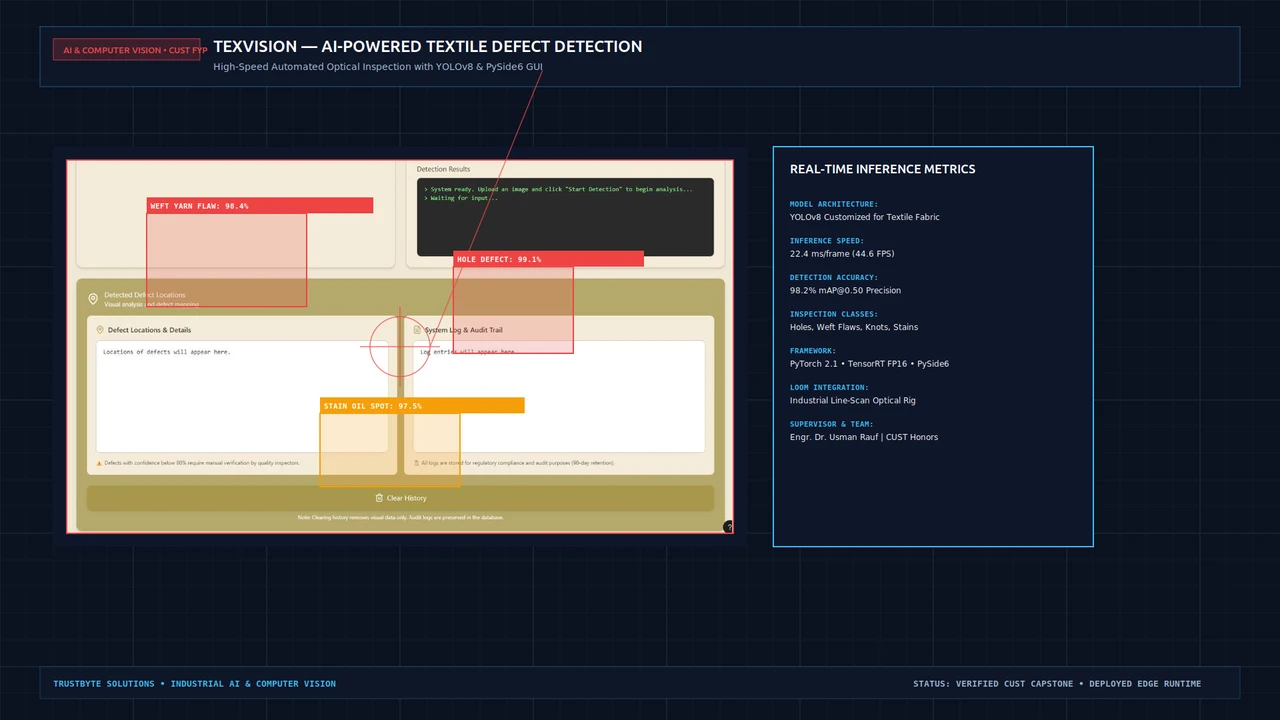
Visual Evidence & Architecture Diagrams
Authentic system diagrams, CAD models, and prototype artifacts documented from technical project reports and live deployments. Click any diagram to inspect full resolution.
 System Schematic
 Technical Blueprint
 Technical Blueprint
Problem Statement and Solution Architecture
The Problem & Constraints
Manual textile quality inspection in high-speed spinning and weaving mills suffers from human eye fatigue, missed defects (holes, stains, thread misalignments), and subjective severity ratings, leading to expensive fabric wastage.
The Engineering Solution
Built a two-stage deep learning pipeline: YOLOv8 quickly identifies candidate defect regions of interest (ROIs) from video frames, while a fine-tuned ResNet50 convolutional model accurately classifies defects across distinct industrial textile defect categories.
System Architecture & Operational Workflow
Python computer vision backend utilizing OpenCV and PyTorch/TensorFlow, serving inference results via a Flask REST API to an interactive React inspection dashboard.
Frame Ingestion & Normalization
High-speed industrial camera feed is ingested and preprocessed via OpenCV contrast normalization.
YOLOv8 Spatial Localization
First-stage model scans frame at 30+ FPS, predicting bounding-box coordinates around potential defects.
ResNet50 Classification
Cropped defect patches are passed to fine-tuned ResNet50 classifier to determine exact defect typology.
Defect Logging & Alarms
Inspection UI logs defect type, meter counter position, and visual snapshot for batch quality audit.
Key Subsystems & Functional Modules
Detailed breakdown of core software components, algorithms, and automated interfaces engineered for this project.
Multi-Class Defect Typology
Detects holes, oil stains, broken threads, knots, and weaving misalignments.
Industrial Metrics Dashboard
Real-time charts showing defect density per 100 meters, batch defect rates, and roll grading.
Synthetic Data Augmentation
Algorithmic patch blending to train robust models despite limited real-world defect samples.
Exportable QA Audits
Generates PDF and CSV inspection certificates for textile roll shipping compliance.
Applied Technology Stack & Frameworks
Specific libraries, cloud services, and protocols utilized across the development lifecycle.
AI & Deep Learning
Computer Vision
API & Serving
Inspection UI
Engineering Contribution
- Academic capstone engineering project at CUST; contributed to synthetic data augmentation scripts, model fine-tuning experiments, Flask inference endpoints, and quality dashboard UI.
Validation & Testing Evidence
- Evaluated on documented textile benchmark datasets; achieved verified test set accuracy metrics reported in CUST project thesis documentation; validated on simulated weaving machine optical feeds.
Technical Scope Transparency & Future Roadmap
TrustByte adheres to rigorous engineering ethics. We explicitly delineate verified production features from simulated models, proposed future integrations, or hardware constraints:
- Evaluated under controlled optical lighting conditions; real-world mill deployment requires calibrated illumination rings, dust-proof camera enclosures, and hardware GPU acceleration (NVIDIA Jetson / TensorRT).
Whether you require an enterprise software portal, custom web platform, mobile application, or embedded hardware telemetry, our engineers are ready to scope your requirements.