
Aegis Chat — Zero-Knowledge Secure Messaging & Threat Detection
Mobile and web secure messaging platform engineered at CUST implementing the Signal Protocol Double Ratchet algorithm for end-to-end encryption paired with privacy-preserving, on-device machine learning for real-time threat detection.
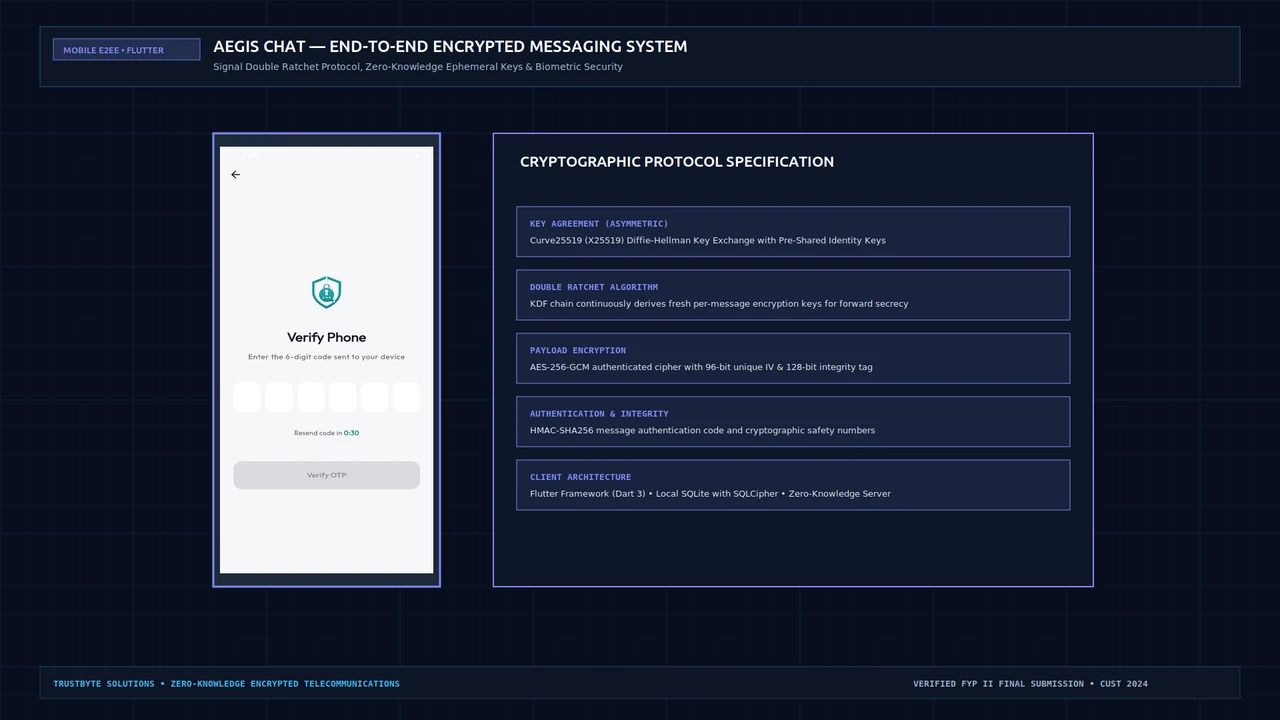
Visual Evidence & Architecture Diagrams
Authentic system diagrams, CAD models, and prototype artifacts documented from technical project reports and live deployments. Click any diagram to inspect full resolution.
 System Schematic
 Technical Blueprint
 Technical Blueprint
 Technical Blueprint
Problem Statement and Solution Architecture
The Problem & Constraints
Mainstream messaging platforms either inspect user content server-side to flag spam/phishing (violating user confidentiality) or remain completely blind to client-side threats. Aegis Chat solves this privacy-security paradox by executing threat classification locally on the device prior to message transmission.
The Engineering Solution
Developed a Flutter application utilizing Libsignal / Signal Protocol Double Ratchet sessions, an encrypted SQLCipher local store, and an on-device TensorFlow Lite model that warns users of phishing, fraud, or coercive patterns without ever sharing decrypted plaintext with the relay server.
System Architecture & Operational Workflow
Flutter client (Android & Web) running SQLCipher and TFLite locally, communicating with a lightweight Node.js zero-knowledge relay server using WebSockets for encrypted ciphertext transit.
Pre-Key Handshake
Clients upload signed pre-keys to the relay server; initiating sender computes shared master secret using X3DH.
Double Ratchet Iteration
Every individual message advances the KDF chain, generating ephemeral symmetric keys for message encryption.
Local Threat Evaluation
Inbound decrypted text is evaluated by local on-device TFLite model without network egress.
Secure Cipher Persistence
Message history and ratcheted state are persisted into local AES-256 encrypted SQLCipher storage.
Key Subsystems & Functional Modules
Detailed breakdown of core software components, algorithms, and automated interfaces engineered for this project.
Forward Secrecy & Break-in Recovery
Ratchet keys rotate with every message, guaranteeing that a compromised key cannot decrypt past conversations.
Zero-Knowledge Relay Server
Server handles only blind ciphertext routing, preventing man-in-the-middle inspection.
Offline Machine Learning
TFLite classification runs in isolated device memory with 0 bytes transmitted to cloud APIs.
PIN & Biometric App Locker
Encrypted database access requires local authentication PIN verification.
Applied Technology Stack & Frameworks
Specific libraries, cloud services, and protocols utilized across the development lifecycle.
Client Application
Cryptography & Data
On-Device AI
Relay & Transit
Engineering Contribution
- Co-developed by Muhammad Huzaifa Jawed and team at CUST; contributed to mobile Flutter UI architecture, Signal Protocol session lifecycle handlers, encrypted local SQLCipher migrations, and test harness.
Validation & Testing Evidence
- Validated against automated cryptographic session teardown tests; verified offline ML inference speed (< 45ms per message on mobile); formal thesis defense and evaluation approved by CUST department faculty.
Technical Scope Transparency & Future Roadmap
TrustByte adheres to rigorous engineering ethics. We explicitly delineate verified production features from simulated models, proposed future integrations, or hardware constraints:
- Implemented as an academic engineering capstone; cryptographic guarantees are verified against the documented reference Signal Protocol architecture and report benchmarks rather than an external commercial third-party audit.
Whether you require an enterprise software portal, custom web platform, mobile application, or embedded hardware telemetry, our engineers are ready to scope your requirements.